
A conveyor stops during a busy production shift. A technician is called to inspect the jam, while the operator steps away to handle another task. Someone farther along the line believes the work is finished and restores power. The machine begins moving while a person is still in a hazardous area.
Important editorial note: This is a fictional training scenario, not an account of a verified accident. It illustrates how an unplanned equipment startup can occur when energy control, communication, and work authorization fail. No real people, employer, date, or investigation findings are being described.
Unexpected machine movement can expose workers to crushing, entanglement, or struck-by hazards. Understanding the potential chain of events helps safety teams examine their own procedures before a similar emergency develops.
The Scenario: A Jammed Conveyor During Production
Imagine a packaging facility with several connected conveyors. An operator reports that a transfer point is blocked. A technician arrives and discusses the problem briefly with the operator. Production staff are focused on restarting the line because outbound orders are behind schedule.
The technician turns off the local controls and begins assessing the jam. However, the equipment has more than one energy source and can receive commands from a remote station. No complete equipment-specific energy-control process has been carried out.
During a shift handover, another employee sees the local panel stopped but does not realize servicing remains underway. A restart request is sent from another part of the line. Movement occurs unexpectedly.
The situation is fictional, but the hazards are recognizable: interconnected controls, stored or available energy, insufficient communication, and pressure to restore production.
Why the Stop Button Was Not Enough
An operating control may stop a process without physically isolating every hazardous energy source. Other circuits, stored pressure, spring forces, or elevated components can still create danger, depending on the machine.
OSHA’s lockout/tagout standard, 29 CFR 1910.147, establishes requirements for covered servicing and maintenance where unexpected energization, startup, or release of stored energy could injure workers.
For an introduction to these requirements, see What Is Lockout/Tagout and Why Is It Important?.

Where the Protective System Failed
Failure 1: Incomplete Hazard Recognition
The team treated the conveyor as a simple local machine. In reality, connected equipment may receive commands from several points or retain energy after the visible motion stops. A job plan should account for the actual machine configuration and every relevant energy source.
Failure 2: No Verified Isolation
The technician relied on a control state rather than a verified isolation process. Under OSHA’s applicable provisions, authorized employees must control hazardous energy and verify isolation and de-energization before beginning covered servicing work.
A lock placed on the wrong disconnect does not solve the problem. The procedure must identify and address the correct sources and stored energy hazards for the equipment.
Failure 3: Poor Communication and Coordination
The incoming employee did not know that maintenance remained underway. This illustrates why operators, technicians, supervisors, and contractors need a shared understanding of equipment status. Restart authority should never depend on informal assumptions about whether a job appears finished.
Failure 4: Production Urgency Overrode Procedure
A rushed repair is more likely to expose gaps if workers believe that finishing quickly matters more than following established safeguards. Leaders should design work planning so adequate isolation, repairs, and verification remain normal parts of the schedule.
Failure 5: Weak Return-to-Service Controls
A safe process needs a defined handoff before equipment is returned to normal operation. The work area and machine must be checked, employees accounted for, required devices removed under applicable procedures, and affected employees notified before startup.
What a Better Process Would Consider
OSHA’s energy-control requirements involve preparation, shutdown, isolation, application of lockout or tagout devices as appropriate, control of stored energy, and verification. Actual requirements depend on the work and the scope of the standard. This overview is educational and is not a substitute for site-specific procedures or authorized employee training.
Identify Every Relevant Energy Source
An equipment-specific assessment may include electrical power, pneumatic or hydraulic pressure, gravity, moving parts, and linked machines. Physical isolation devices, safe access arrangements, and documented responsibilities must reflect the actual system.
Coordinate Multi-Person Work
When multiple employees or contractors service equipment, the group needs appropriate individual protection, clear responsibility, and shift-transfer procedures. OSHA specifically addresses group lockout/tagout and contractor coordination.
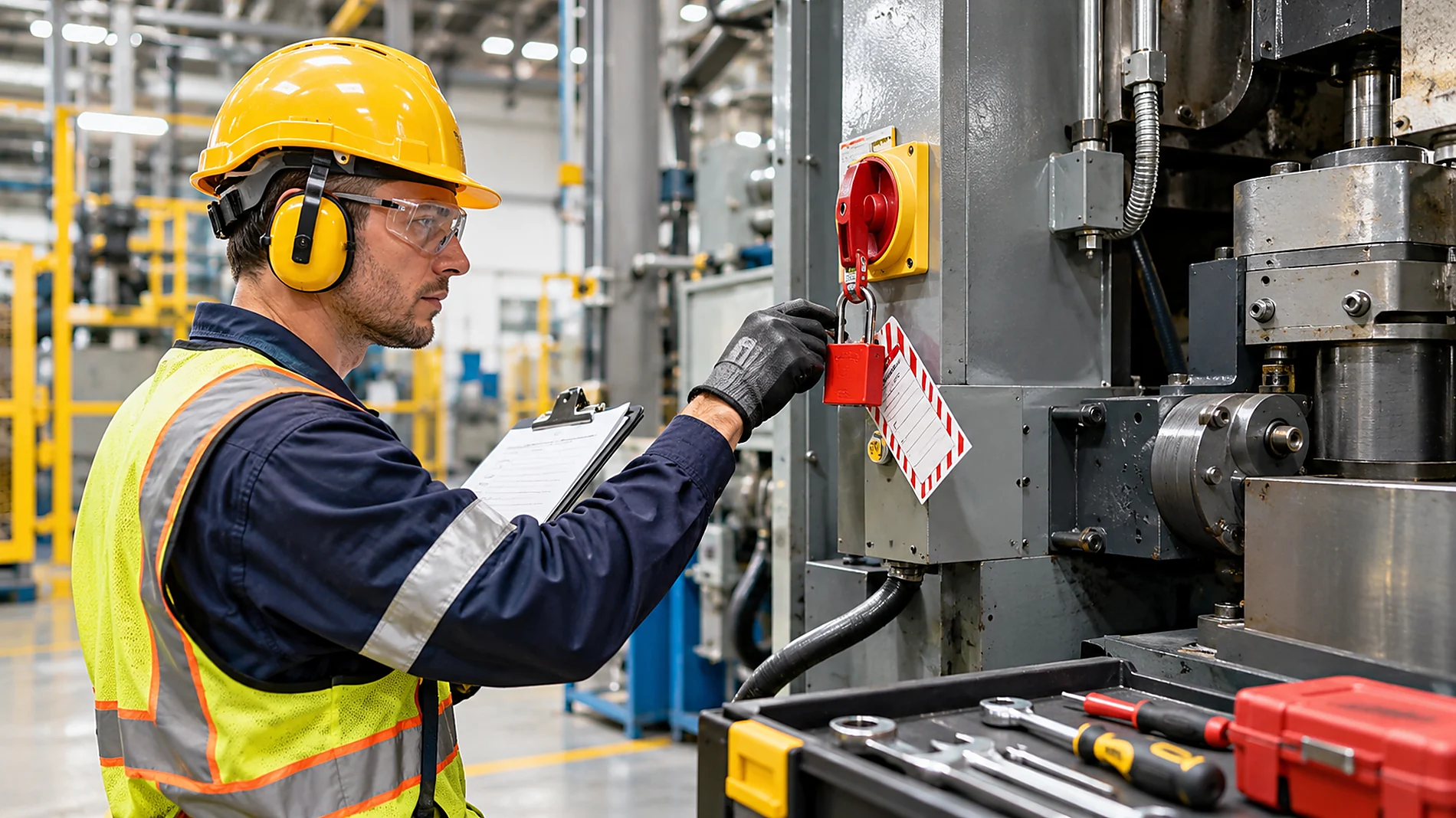
Verify Conditions Before Work and Restart
Verification should confirm the required isolation, not merely the appearance of a stopped machine. At the end of work, designated personnel should verify that the area is safe and safeguards are restored before energy is returned according to the established process.
A Key Training Question
Ask: “Who can establish that this equipment is safe to service, and who can authorize its return to operation?” Every affected employee should know the answer relevant to their role. Confusion about responsibility is itself a finding to resolve.
Five Questions for an Incident Review
Even when no injury occurs, an unexpected motion or near miss deserves investigation. A useful review examines the system rather than stopping at “someone pressed start.”
- What energy sources and control points were present?
- Which workers knew servicing was taking place, and how was that information shared?
- Were required isolation, guarding, and verification measures available and used?
- Did the job schedule, staffing, design, or training encourage shortcuts?
- What changes would prevent the same sequence from recurring?
OSHA’s hazard assessment recommendations encourage reviewing incidents and near misses to identify underlying hazards and corrective actions.
Turn Lessons Into Changes That Last
A company might need to update equipment-specific procedures, improve labeling or work authorization, modify access or guarding, strengthen contractor coordination, and retrain employees on their responsibilities. Corrective actions should be tested and reviewed rather than closed because a meeting occurred.
For related maintenance planning, read The Maintenance Factor: Keeping Equipment Safe, Reliable, and Ready. Strong planning can expose hidden startup hazards before servicing begins.
Do Not Confuse Training Scenarios With Incident Reports
Fictional examples can help readers discuss dangerous situations, but they are not evidence that an accident happened at a particular facility. When publishing verified incident analysis, identify the original investigation, location, date, and documented findings. Clearly separate confirmed facts from interpretation.
This distinction is especially important for an industrial safety journal: credible learning depends on knowing whether a story is a documented case or an illustration of a possible failure.
Final Takeaway
An unplanned startup is rarely explained by a single button press. The dangerous conditions may include unidentified energy, incomplete isolation, insufficient coordination, and unclear restart authority. Workplaces can reduce these risks by using correct hazardous-energy controls, preparing for nonroutine tasks, supporting employees who raise concerns, and verifying that safeguards remain effective under real operating conditions.